|
|
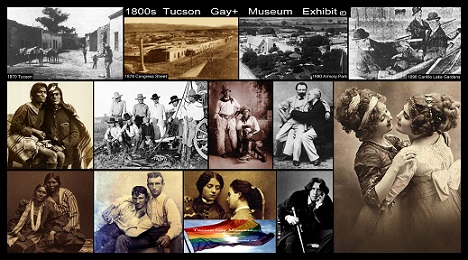
1800's Far out in the wild territories of the 1800's which Tucson was definitely considered being a part of, and very rightly so, the settlement maintained its very small population of 395 people in 1821 mostly made up of soldiers and others directly related to the Presido (fortification) with their structures built adjoining the forts walls. Ten years later in 1831 the population of the Old Pueblo had risen to 465. By 1864 with the arrival of United States and other citizens, soldiers, merchants, con artists, miners, gamblers, and fortune hunters after the United States war (see article) with the struggling United Mexican States between 1846-1848, as Tucson's population had quickly grown to 1,568. Again by the time of 1870 the town had grown to 3,224 people within the town limits of two (2) square miles who faced other far more pressing daily life concerns than who did what with whom and when out of public view. Daily life was extremely hard in and around the Old Pueblo, and a person's lifespan often very much depended on their abilites to find just the basics of adequate food, water, and shelter. Hostile Indians, dust storms that could block out the sun, oppressingly hot weather, cowboys, adventurers, gamblers, assorted bandits, highwaymen, horse & cattle thieves, and a veritable host of poisionous desert creatures were also a very serious real and constant daily concern. One traveler remarked about his visit to Tucson in 1858, "It is very dirty and smelly, dead animals lay out in the streets where they fell or were thrown and the people throw their garbage right out their front doors. Everyone is armed to the teeth, and daily gunfights and knife fights are just common place. it is a real haven for the damned."
Same Sex Relationships thus formed and sometimes flourished within an almost anything goes atmosphere in Tucson during much of the era of the 1800's. As one Spanish Military Officer assigned at the Presidio commented publicly to one of his non-comissioned officers in 1820 shortly before being recalled to Spain after the founding of the Mexican Empire as its own entity, 'Tell the people they can do as they wish as long as they do not disturb the horses, Bullocks a.k.a. ox carts, or wagons out in the plaza.' The
1800's
also brought about many very new ideas and attitudes toward
homosexuality.
Before then
those who had same sex relations with others
usually had not been viewed as people who were
homosexual,
but instead as people who happened to engage in sexual acts with members
of their own gender. In other words,
homosexuality was something one did,
and not
something one was.
Those believing in this thought that people consciously
chose to perform
homosexual acts, rather than that they suffered from
disease or
psychological deviancy. But, both of those public
opinions would become popular later on in history. As a result any
homosexuality was considered a
crime which was in some cases
punishable
by death in some places in the world. During the years between
1800 and
1835,
over one hundred (100) men were
executed by public hanging
in England alone for committing
sodomy. In the
1830's
in
Imperial Russia the word
muzhelozhstvo
which means
men lying with men
and basically
having anal sex was
punishable by up to five years of
Siberian exile.
Being a Lesbian did not escape the public's wraith either when in the summer of 1810, two teachers Marianne Woods and Jane Pirie were both accused of improper and criminal conduct by one of their student's mother. Elsewhere over in Europe a more liberal stance was popular. It was the year 1804, when France updated its Code of 1791 (which was later renamed The Code Of Napoleon). It decriminalized all private sexual acts between consenting adults. Even with all the changes elsewhere, England in 1828 with its Offenses Against the Person Act made it very simple to get the amount of proof needed for anyone to be convicted of sodomy.
Although persecution of homosexuality in the 1800's, combined with no standard terminology, made it impossible for unified and visible sub-cultures to exist. Still some individual same sex relationships did occasionally surface to the public forefront. In the America of 1834 a forty-three (43) year old attorney named James Buchanan, who would later become President of the United States, met William Rufus De Van King. The two of them became inseparable companions for many years living together in Buchanan's home. Buchanan and William King's relationship was very well known in political circles. General Andrew Jackson referred to Mr. King as Miss Nancy while others called William Rufus De Van King, "Buchanan's Better Half. " In 1862, then Confederate States of America President Jefferson 'Jeff' Finis Davis signed a bill recognizing Arizona as a Territory of the Confederate States Of America. His presidential act took effect on Friday February 14, 1862 which was ironically exactly 50 years before the Arizona Territory became a state of the United States. The Arizona Territory had originally been claimed by the Confederate Army on Thursday August 1, 1861 with the support of many of the towns people, following the Confederate victory at the 1st Battle of Mesilla when retreating Union Colonel Edward Richard Sprigg Canby and his troops surrendered to Confederate Lt. Colonel John Robert Baylor. On Thursday February 27, 1862 the Confederate Captain Sherod Hunter in command of Company A of the Arizona Rangers entered Tucson with 247 men with very few women or other diversions anywhere to be found. The sudden abandonment of Tucson by all of the posted U.S. Federal Army Troops earlier after the start of the Civil War leaving the residents unprotected from the constant Apache Indian attacks and raids set the stage for the Confederate Troops to be warmly welcomed by many of Tucson's citizens.
In the Americas,
the Europeans and Americans studying Native Americans discovered the presence of
Berdaches,
men who dressed in typical female garb and
assumed the duties
of women.
Berdaches also
served a spiritual role in the life of almost all Native American societies.
In the Tohono
O'odham (previously called the
Papago) tribe in and around
Tucson they
were highly prized to
give special good luck names to both children and
adults. One of the more famous
Berdaches,
We'wha of the Navajo,
traveled to
Washington, D.C. in
1886 where he charmed many there including the then
President Grover
Cleveland. In
1860 an
American Poet Walt Whitman
(see Walt Whitman Archives) published his book titled
Leaves of Grass
that contained many references to the
bonding
& love
that happens between men.
The American Public both loved the book, while others called it obscene and hated it. Regardless, its printings continued to be completely sold out one after another very quickly upon being placed on the shelves or ordered by mail. In time his book titled Leaves of Grass found a wide acceptance in Europe and became an International Sensation right along with his many poems. Toward the last years of the 1800's sexologists began practicing around Europe. Being mostly men, they analyzed sexuality and were considered some of the first to create a basic vocabulary of words that would be used to define homosexuality for many years in the future. Finally, it was 1869 when Karl Maria Kertbeny coined the term homosexuality. The word Homosexuality was first used in an anonymously published pamphlet, in which Kertbeny advocated the repeal of Prussia's sodomy laws. Sexologists would go on to debate the nature of homosexuality for many years after Kertbeny's book and the pictures inside it were published.
On Saturday March 20, 1880 the Union Pacific Railroad steamed into Tucson driven by Engineer Jack Bruce (see article) and belching fire & smoke at its new train station as a continuing part of the United States program of the Intercontinental Railway to link the country together. By that time Tucson's population had grown to 7,007 as it began taking its place as the major supply center for the area. Along with the arrival of the railroad to the city in 1880 came the delivery of huge blocks of ice in insulated freight cars which other than the once a year limited ice hauled down by horse drawn wagons from Mt. Lemmon was Tucson's first real dependable refrigeration source for both food use and in the saloons to provide cold drinks supplied by the Artic Ice Company (see ad) (see listing) under the ownership of Royal A. Johnston with its office located at 20 S. Church Street. On Wednesday August 19, 1857 the first scheduled Pony Express style mail to come into the dangerous Arizona Territory arrived in Tucson with the mail pouch carried on horseback. Mail rider James E. Mason had left San Antonio, Texas, on Thursday July 9, 1857 and did not arrive in the Old Pueblo until Wednesday August 19 because it he was delayed by a Comanche Indian attack that occurred just east of El Paso, Texas. On Saturday September 16, 1882 before a raucous and semi-sober crowd the first water was pumped up from the Santa Cruz River and began flowing through the pipes and finally out the nozzles of the Tucson Water Company's Main Water Lines at the corner of Congress and Main Streets in Tucson for residential or commercial customers at a charge of 2 cents per bucket filled. Many residents were astounded by the high price of the "delivered water" and instead continued to manually fetch their water in buckets, bags, and pouches from down at the rivers edge and carry it home themselves. Men in Tucson, Arizona could discretely meet other men at a selected few saloons, cafes, and cigar stores which offered very private sampling and club rooms such as Rossi's Cigar Store & Club (see ad) under ownership of Alexander Rossi (see ad) (see ad) located at the corner of Stone Avenue & Congress Street, the Arizona (Saloon) Club (see ad) under ownership of Thomas McDermott (see ad) and Fredrick Dale (see listing) located at 102 Congress Street, the Reception Saloon (see ad) under ownership of O.J.H. (Skinny) Johnson located at 112 W. Congress Street, the Depot Park Hotel & Saloon (see ad) (see listing) under the ownership of George Sicocan (see ad) located at 36 5th Avenue right across the dirt street from the train depot, and the Cactus Saloon (see ad) located at the corner of Toole Avenue & 5th Avenue under ownership of partners Mr.'s Bohn and Heidel (see ad) (see listing). In society at large, however, Homosexuality was still considered a crime. In one of the most notorious trials of the 1800's, the flamboyantly Gay British author and playwright Oscar Fingal O'Flahertie Wills Wilde was charged and tried for sodomy and indecent behavior in 1895. Despite his lengthy, heartfelt, and seemingly convincing appeals to the court about the love between men he was convicted, sentenced, and served two years in horrible prison conditions and forced hard labor. The great author of novels such as The Picture of Dorian Gray, The Canterville Ghost, and plays including The Importance of Being Earnest , the once dashing Oscar Fingal O'Flahertie Wills Wilde, later died in poverty penniless in a Paris flop house and converted to Catholicism on his deathbed (see article...Gay Icon Embraced...page #12) on the 30th of November in 1900. 1889 Oscar Fingal O'Flahertie Wills Wilde
Around Tucson in the latter 1800's same sex seeking persons often inconspicuously met or went on dates far north of the city limits at the privately owned Pastime Park (later in the early 1900's the land would become the area's first Veterans Hospital when returning veterans began squating on the property and putting up their tents) was located along the west side of the dirt Oracle Wagon Road heading north. The private park was part 24 hour open bar with many bringing their own bottles of liquor, part pleasure park-amusement park with some rides, dancing, bowling, skating, carnival games, etc of the era, and part neutral zone far away from the reach of Tucson and Pima County officials and their law enforcement. In Tucson itself during the later 1800's the saloons (a.k.a. private men's clubs as they were sometimes called) men congregated and discretely established private relationships in an era before the advent of radio and television as entertainment diversions at places such as Hanson's Place (see ad) owned by John F. Hanson (see ad) which took up the addresses from 11 to 23 W. Congress Street, the Occidental Hotel (see ad) under ownership of S.W. Sutherland (see ad) located at 62 S. Meyer Street which was a stop for the daily stagecoach and favorite stopover of lawman Wyatt Earp and his brothers when in town on business, or the The Conductor (see ad) a very discrete all male rooming house located at 191 S. Stone Avenue under ownership of F.L. Willson (see ad) who was known to provide boarders with great privacy.
By
1898
Tucson had its own ambulance (see
photo), and
Health Department/Board of Health that oversaw those
matters within the city limits. In its
1898 Annual
Health Report the city population was listed at
around
10,000,
a total of 118 babies born,
44 cases of
scarlet fever,
17 visits to the city jail, and
35 visits to the Pest House were made where those with communicable
diseases were
Quarantined
away from the public. While the
sexologists of the later
1800's made it easier for
same sex interested people to find the words to describe their lives, it
did not convince society in general that
Homosexuality
especially in
Male on Male
Love
was still not a crime against nature. Meantime,
Oscar
Fingal
O'Flahertie Wills Wilde's sensational
court case,
very harsh
imprisonment, and
equally tragic circumstances for only loving a person
of the same sex sadly began the
next upcoming decade of the 1900's.
FAIR USE NOTICE:This site contains copyrighted material the use of which has not always been specifically authorized by the copyright owner. We are making such material available in our efforts to advance understanding of environmental, political, human rights, economic, democracy, scientific, and social justice issues, etc. We believe this constitutes a “fair use” of any such copyrighted material as provided for in section 107 of the US Copyright Law. In accordance with Title 17 U.S.C. Section 107, the material on this site is distributed without profit to those who have expressed a prior interest in receiving the included information for research and educational purposes. For more information go to: http://www.law.cornell.edu/uscode/17/107.shtml. If you wish to use copyrighted material from this site for purposes of your own that go beyond “fair use,” you must obtain permission from the copyright owner, including the Tucson Gay Museum®© and provide an acknowledgement-link back to this site as a professional courtesy. Publication of names, photos, exhibits, manuscripts, artifacts, memorabilia of any person or organization in the TUCSON GAY MUSEUM a.k.a. Tucson LGBT Museum and Tucson LGBTQ Museum is not to be construed as indication of the sexual orientation of such person(s), organization(s), advertisers, or any employees thereof.
|