|
|
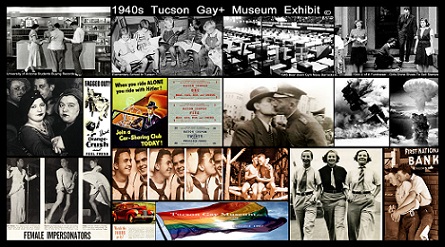
1940's My Cousin Was On The U.S.S. Arizona, I'm Enlisting Today - University of Arizona College Student on December 7, 1941 As Tucson entered the 1940's, it was still a somewhat sleepy backwater town of 36,818 people within the city's 7.8 square mile limits with some horses and wagons being seen on the streets as they were becoming quickly replaced by automobiles. Out at the University of Arizona (originally started and named as the Arizona College of Mines) the original building Old Main sat empty and some roof timbers had fallen down forcing it to be condemed by authorities due to disrepair from a period of neglect and lack of use. It was scheduled for demolition as soon as the funds became available.
Suddenly, on the morning of December 7, 1941 (see video exhibit) (see video exhibit) with the attack on Pearl Harbor and sinking of the USS Arizona and many other ships, Old Main, Bear Down Gymnasium, Tucson, and the entire world was changed forever as hundreds of thousands of young men (many just teenage boys 14-17 lying about their age) soon passed through very rushed military training (see video) (see video) at the quickly remodeled Old Main that was pressed into service as a military training center along with Bear Down Gymnasium which was turned into an all male barracks and military training (see video) center as World War 2 (see video) (see video) (see video) had just landed on Tucson's front door step!
Soon
war materials
related factories (see
video) and businesses began
opening up
around Tucson. For
Tucson's
Gay's
and Lesbian's it meant jobs,
jobs, and more
jobs working at home in the
Old Pueblo. For the able bodied men it meant being
shipped out at the train station downtown to military training camps all
over the United States,
and being sent up to the
front
to fight. Often during the initial processing the
inductees
were suddenly asked,
Are You A Homosexual? To which everyone would of
course say NO and move on to the next procesing
station. At the time
Gays & Lesbians
only had their
GAYDAR
to operate with and would form into
small groups to
safely share their
secret stories with. In
Washington D.C. the
First Lady
Eleanor Roosevelt lived her
Bisexual Life, married to the
President Franklin
Roosevelt, but had her
four year long love and
relationship affair with
Associated Press
journalist Lorena
'Hick' Hickock who had originally been assigned to cover the White
House.
First Lady
Eleanor was a champion for
human rights & freedoms and always pushed hard for them. Curiously, her husband
Franklin Delanor Roosevelt had an
affair with Eleanor's secretary in 1918, and after that
Eleanor refused to
and
never had any further sexual contact with her
husband for the rest of
her life. Over in both the
European and
Asian Theatre's of
World War 2 the fighting had been already been raging
along prior to the
United States entering it. In 1940 German troops marched into
France, then
into its capital of Paris
and took over the country making it a part of
Germany.
German
officials had worked out a
system of identification for
its undesireables & enemies of the
state. Thus was born the
Pink Triangle
(see video)
as an identifier of
Gays
(see video) and could include both
Gay's & Lesbians (see
video) in both in
Germany and the growing list of the many countries it was rapidly taking over and
making a part of its
Nazi Empire (a.k.a.
Third Reich - 3rd Rein in
English) (see
map). In
Germany all
Gay's were
sent to
prison or the
concentration camps (the
first was setup on March 10, 1933) as the
lowest form of
prisoner and
automatically scheduled for
extermination
regardless when or if carried out.
In Tucson Gays , Lesbians , and a wide variety of Hipsters still discretely met at times in dark hotel bars or cafes at Hotel Congress, Pioneer Hotel, Santa Rita Hotel, the Red Light Districts until they were shut down, and the first Gay Bar (but with a mixed crowd including many Bisexuals) called the Town House Bar located downtown at 34 S. Scott Avenue which soon started attracting a growing and regular Gay crowd. The city's Gay movers and shakers of the time were Ray Birmingham, Terry Cohen, Tom Garnish, and George Rederus (see In Memoriam page #6) who regularly hosted private outdoor outings around the Tucson area and many events at their own homes mostly on weekends as Sunday Clothing Optional Pool Parties, BBQ's, and Potluck Dinners which usually included fun games-dancing-contests and Stand Up Drag or other performances. Also on Sundays there was always a standing dinner invitation to all Gays to meet at El Torero Restaurant at 231 E. 26th Street where one could be their Gay Self without any worries. Additionally, the Red Light District's of Tucson and any city for that matter had always provided places where Gays-Lesbians could blend in and often secretly own-operate some of the establishments and bars there.
Around
Tucson and
elsewhere in the U.S. with America's entrance into
World War 2 on
December 7th,
1941 (see video), a very sharp and monumental change happened in
Lesbian culture.
Suddenly there was a critical need for
all able bodied men
(see video) to
leave their jobs for
service in the military
(see video) and the
demand for labor in
Tucson's
war parts
factories and
other operations, many of which were located
south of the city in
Pima County where later
Tucson's International
Airport would be located, immediately thrust all available
women into the
workforce often including
high school teenagers. The abrupt
absence of men
quickly increased
females bonding leading to
relationships and intimacy at
the
Tucson home front.
The same happened to the hundreds of thousands of women who had enlisted in the military, which at first during the time was very lenient toward Lesbianism because they badly needed servicewomen. Ironically, when the war ended and women were no longer needed for the war effort, military Lesbians were systematically found out, discharged, then shipped back to the nearest American port where they had to make it back home on their own. This huge shipment of Lesbians to large urban areas such as Los Angeles, New York, San Francisco, Seattle, and even the small Tucson largely contributed to the growth of Lesbian Culture in the cities around the United States.
During the
early 1940's
Tucson saw a
very large influx of
military men and
women from all around the
U.S. who brought with them
big city desires.
Tucson's
two Red Light
Districts were still in full swing, but repeated
demands by
military
officials to
shut them all
down fell on deaf ears
at first with city officials during a time when
Henry O. Jaastad served as Mayor and
Harold C. Wheeler served as Police Chief until
finally the
military threatened to make the
entire city of
Tucson
Off
Limits to
ALL military personnel and
ALL military
commodities
buyers.
Understanding that if not one of the thousands of military men and women then stationed in Tucson would not be allowed to leave their bases, and the military purchasing agents-buyers would not be allowed to purchase any needed supplies in Tucson, and its resulting economic loss the city would face as it was literally just barely crawling out of the Great Depression (see 1930's-1920's) was too much for the city fathers and the red light districts along with their underground Gay-Lesbian owned or friendly establishments disappeared almost overnight. To insure compliance armed soldiers patrolled the areas 24 hours a day until the army generals were sure there was nothing still operating.
On the federal level by 1944, a new U.S. Military Policy Directive decreed that homosexuals were to be committed to military hospitals, examined by psychiatrists and discharged under Regulation 615-360, section 8, which soon led to the term He is a Section 8. During this time many in the military who had at times openly been involved in same sex activities, had realtionships, had been frequenting suspected or known bars-establishments went deep underground and became even less trusting of those outside their circle of friends they already knew in order to escape the purges that would destroy their military (and often into their civilian) records for life. From the end of World War 2 in 1945 with the surrender of Japan and then Germany , there was great pressure in the remaining 1940's on everyone to have mainstream nuclear families which pushed many Gays and Lesbians to try marriage with opposite sex partners, and even well known Homosexual Figures in the U.S. joined in. For the Bisexuals of the era that transition was far smoother. At times the fear of communism was joined with the fear of homosexuals often for political gain. Both actual and merely suspected Gays and Lesbians were fired from their government jobs as the seeds for a full scale witch hunt began to germinate . One popular element of this fear were the cheap dime store pulp fiction novels, written about the always sensational racy escapades of seemingly endless wildly neurotic and crazed fictional Gays and Lesbians. In 1947 Gay film maker Kenneth Anger's Homoerotic' film 'Fire Works' was released during a time when Homosexuality was illegal in the United States.
Still, in Tucson in 1949 as the decade of the 1940's came to an end with a population of 44,548 inside the 9.5 square mile city limits, it could be a place that often afforded those of Hipster Alternate Lifestyles some respite and the ability to find their own niche in The Old Pueblo regardless of how they did things any place else.
FAIR USE NOTICE:This site contains copyrighted material the use of which has not always been specifically authorized by the copyright owner. We are making such material available in our efforts to advance understanding of environmental, political, human rights, economic, democracy, scientific, and social justice issues, etc. We believe this constitutes a “fair use” of any such copyrighted material as provided for in section 107 of the US Copyright Law. In accordance with Title 17 U.S.C. Section 107, the material on this site is distributed without profit to those who have expressed a prior interest in receiving the included information for research and educational purposes. For more information go to: http://www.law.cornell.edu/uscode/17/107.shtml. If you wish to use copyrighted material from this site for purposes of your own that go beyond “fair use,” you must obtain permission from the copyright owner, including the Tucson Gay Museum®© and provide an acknowledgement-link back to this site as a professional courtesy. Publication of names, photos, exhibits, manuscripts, artifacts, memorabilia of any person or organization in the TUCSON GAY MUSEUM a.k.a. Tucson LGBT Museum and Tucson LGBTQ Museum is not to be construed as indication of the sexual orientation of such person(s), organization(s), advertisers, or any employees thereof.
This website is dedicated to all those of the Tucson LGBT Community that have come before, are here now, and will take our places in the future of Tucson, Arizona, U.S.A. Home | About The Museum | Explore Exhibits | Visit Special Collections | Site Map | Disclaimer
|