|
|
1960's
'Things Have Got To Get Better Than This, They Were Waiting For Us' ... Antonio, a Young Tucson Gay Man after being beaten by plainclothes undercover police when leaving a Gay Bar through the back door while uniformed police rushed in through the front door to force them to the back.
1960 in
Tucson Arizona began with a population of 212,892
within its 45.8 square mile city limits and by
1969 had reached
255,724 residents within its 76.5
square mile boundaries that had grown with annexations
into the city.
By the November of
1960,
Dennis (Denny) Smith whose success with the
Lil Brown Jug Gay
bar
located at 431 East Grant Road
in
Tucson
during the 1950's (see 1950's), and the growth of
the city population into that area, led him to search out another
Gay Venue in a
quieter area with less chance of public
complaints and
police harassment.
Dennis Smith began negotiating with
the owners of the straight bar,
Angelina's located at
1749 Miracle Mile Strip, later renamed North Oracle Road, in what was then only a partially developed
area of Pima County north of Tucson. Angelina's bar had been a
full liquor establishment, its interior
was large with high ceilings, and it hid a
secret back entrance
disguised as a service door cleverly hidden behind
some trash cans and
wooden crates.
1960's Around Gay Tucson® While the bar operated up front to the public, through the secret door Private Members for a monthly fee were given a key to enter the secret door into a hidden large backroom bar and gambling area filled with roulette tables, slot machines, blackjack and poker tables. By the end of November 1960 Smith had managed to purchase the business, refurbished the interior to operate as a Gay Bar, and changed the name to The Corner Cocktail Lounge. Its out of the way location, huge interior, and airy high ceilings atmosphere made it an instant hit taking many of the Lil Brown Jug bar's local patrons as they shifted over to The Corner Cocktail Lounge under ownership of JW Thornton located at 1749 Miracle Mile Strip, later renamed North Oracle Road. Although still popular with some in it's location, on March 12th 1963 the Lil Brown Jug bar, after its run as Tucson's defacto Gay Center of action, closed its doors forever fading into history along with its many fine and special memories for Gays, Bisexuals, and Lesbians. But, the circle was not complete until the Monday after Labor Day September 2, 1963 when The Corner Cocktail Lounge also closed its doors forever.
The 1960's also began the rumblings of angry dissent from a number of groups, the Gay Subculture, and the Bar Culture which had long been suffering from police blackmail, harassment, and gay bashing. For the first time in the United States in 1961 an openly Gay Drag Queen club singer in San Francisco who performed regularly at the Black Cat Bar named Jose Sarria ran for a seat on the Board of Supervisors by campaigning only to the Gay Community and getting over 6,000 votes. Interestingly, Jose would have won because there were no candidates running against him until the very last day for potential candidates to file when city officials noticed he was going to be elected. Suddenly within a few hours a total of thirty four (34) straight people applied as candidates and he did not win the election, but his groundbreaking campaign as a Gay Man was historic. Ironically, from that day forward no candidate in San Francisco has missed the opportunity to make the attempt of getting the favor of Gay Voters in one way or another. Meantime in the 1960's back in the East, Illinois became the first state in the nation to decriminalize homosexuality. The Hotel Congress Tap Room had received its license to serve hard liquor in the summer of 1962 and was still gay friendly, quickly retaking the lead as the Gay Venue of the time until the 1965 opening of Jim's bar which served only beer at the 23 W. University Boulevard location with owners James (Irish Jim) O' Malley (see In Memoriam page #2) and George E. (a.k.a. Handy George a.k.a. The God Father) Rederus (see In Memoriam page #6). The bar became very popular and the two men sold the bar for a very large profit in 1967 to Bruce Stratton who renamed the bar Kamu's and changed it into a straight bar format. Both Jim O' Malley and George E. Rederus then opened Mr. Jim's which quickly became a highly successful Gay Bar in Phoenix in 1967 as both men then focused a lot of their energy into that market. By February of 1964 around Tucson saw the opening of the Black Door Lounge located at 345 E. Toole Avenue and owned by Mr. & Mrs. Tom and Lea Gartley (Tom had been the night time bartender at the Hotel Congress Tap Room bar for many years) located inside the Mac Arthur Hotel also at 345 E. Toole Avenue downtown. During the daytime the Black Door Lounge bar served downtown workers, business people, and hotel guests. But, once the sun went down the Black Door Lounge instantly morphed into a swinging Gay Bar. Although never as successful as the other Gay Venues of the 1960's In Tucson it did have its own unique atmosphere and a very loyal Gay following. Inspired by a police raid on a Gay Bar, in September 1967 the Advocate Magazine started out as a simple newsletter by the activist group PRIDE in Los Angeles for .25 cents a copy.
The Club Esquire (see 1950's) located at 32 S. 5th Avenue and The Manhattan Club located at 46 N. 6th Avenue downtown in the 1960's were at times Gay Friendly and their very Rough Trade patrons added lots of color with both places being the type where you would never sit with your back to anyone and always left your wallet, watch, and rings out in your car. The Ryan-Evans Rexall Drug Store's Lunch Counter was open 24 hours a day at 232 E. Congress Street and for a time was a hot Gay pickup spot along with certain areas at the University of Arizona for both locals and travelers since it was close to the downtown Train Station. Fresh from their success up in Phoenix, in 1969 the James O' Malley & George E. Rederus Team opened Sir James as a Gay Bar located well out of the Tucson City Limits in the rural area located at 4241 Miracle Mile Strip, later renamed North Oracle Road, north of the city in Pima County. The section of the I-10 ( Interstate Highway) (see timeline listing...Construction History) freeway passing through that area of Tucson was completed in 1966. The Sir James bar became very popular with locals who often joked about its rough dirt parking lot's potholes. Both Jim and George being good sports and always seeing an opportunity for some clean fun thought about the parking lot's potholes for a while and decided on a plan. The next Saturday afternoon, the Sir James bar held an un-announced Pothole Toss Contest with each contestant paying $1.00 to attempt to throw a whole peanut in its shell marked with their number from a marked off area into one of the potholes. The lucky patron who threw the most peanuts getting into a pothole would win a Grand Prize of $100.00 in credit on their bar tab. To keep the event Honest each participant was given 3 shots of hard liquor just before going to the Throw Line. With great fanfare the first group of contestants lined up as best they could and began tossing their peanuts. Unknown to the contestants and cheering crowd all around them, early just the day before Jim and George had already test thrown a lot of peanuts, and marked out the throw line just far enough away to make the task impossible. By the end of the contest everyone was fully in very festive spirits, the $238.00 collected from the participants and the $100.00 prize money were combined together, and used to have the potholes filled.
Suddenly, in the early morning of November 22, 1963 an event in Dallas, Texas cleared school yards and sent children home all across the nation. All television and radio was taken over with the sad news, the country went into shock and then mourning. The President of The United States John F. Kennedy (also known to the public simply as JFK and his wife as Jackie during the time), both beloved and hated by many for his unwavering push for the basic civil rights and liberties of all United States Citizens and the setting up of the Peace Corps, had been assassinated and along with it the hope that many Gays, Lesbians, Bisexuals, Transgendered had of finally gaining the rights they so deserved. In 1964 a Life Magazine article brought to Tucson and the rest of the country a 14 page story on Gay Life in the United States. Although the writer called being Gay a "sad and often sordid" life, the article almost despite itself brought news of a nationwide queer culture to Gays, Lesbians, Bisexuals, and the Transgendered to every town, city, and rural area of the entire United States. The previously underground Gay culture was starting to openly assert its social presence with the openings of both the Oscar Wilde Memorial Bookshop in Greenwich Village in 1967, and the Metropolitan Community Church (MCC), a Gay oriented Christian Church founded by an outed & defrocked minister the Reverend Troy D. Perry who started it up in his front room in Huntington Beach, California on October 6th 1968. Tucson would have to wait until the next decade (see 1970's) for it's first all LGBT accepting church.
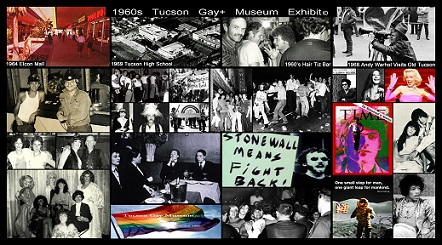
Then the pressure cooker finally blew it's top with the eruption of the Stonewall Riots one night at a Mafia owned and operated Gay Bar selling stolen alcohol from warehouse robberies back east in New York City. It was a series of spontaneous, and often violent demonstrations as gays and lesbians for the first time fought back against a unwarranted harassing violent police raid that took place in the early morning hours of June 28, 1969, at the Stonewall Inn, in the Greenwich Village neighborhood of New York City where the police singled out campy and feminine appearing young gays for special beatings and slamming the police cars rear door on detainee's fingers which sometimes 'accidently' severed them off.
Those riots sparked a coming together of gay power movements across the United States and were the first recorded instance in American history when people of the homosexual community physically fought back against a nationwide government financed and sponsored system that openly persecuted sexual minorities. The Stonewall Riots were the defining event that marked the start of the gay rights movement in the United States and around the entire world. This, in the same year of 1969 that saw the nation's technology land a man on the moon.
As the stroke of midnight December 31, 1969 brought the decade of the 1960's to an end, a war far off in Southeast Asia, the tensions between the classes and interests of different groups in American Society, and the largest generation of young people ever to occupy planet earth who were no longer satisfied with blindly following both their parents or government (a.k.a. The Establishment) had already shaped events in the decade of the 1960's and they would all be right there on the nation's doorstep on New Year's Day in the next decade.
FAIR USE NOTICE:This site contains copyrighted material the use of which has not always been specifically authorized by the copyright owner. We are making such material available in our efforts to advance understanding of environmental, political, human rights, economic, democracy, scientific, and social justice issues, etc. We believe this constitutes a “fair use” of any such copyrighted material as provided for in section 107 of the US Copyright Law. In accordance with Title 17 U.S.C. Section 107, the material on this site is distributed without profit to those who have expressed a prior interest in receiving the included information for research and educational purposes. For more information go to: http://www.law.cornell.edu/uscode/17/107.shtml. If you wish to use copyrighted material from this site for purposes of your own that go beyond “fair use,” you must obtain permission from the copyright owner, including the Tucson Gay Museum®© and provide an acknowledgement-link back to this site as a professional courtesy.
Publication of names, photos, exhibits, manuscripts, artifacts, memorabilia of any person or organization in the TUCSON GAY MUSEUM a.k.a. Tucson LGBT Museum and Tucson LGBTQ Museum is not to be construed as indication of the sexual orientation of such person(s), organization(s), advertisers, or any employees thereof.
This website is dedicated to all those of the Tucson LGBT Community that have come before, are here now, and will take our places in the future of Tucson, Arizona, U.S.A. Home | About The Museum | Explore Exhibits | Visit Special Collections | Site Map | Disclaimer
|