|
|
1970's 'Rights Undefended Are, Indeed, Forfeited,' Huey Beverly (see article... page # 2) - 1970's Gay Rights Activist
If the Stonewall Riots of the late 1960's (see 1960's) were what let the Gay Genie out of the bottle, it was the 1970's that saw him dancing on top of the cork! The Gay Liberation Movement was instantly spread all across the United States and there was no stopping it. Tucson started the decade in 1970 with a population of 262,933 within its 79.5 square mile limits, and finished the decade in 1979 seeing its number of residents within the 96.3 square mile city limits rise up to 320,537. In Tucson on January 19, 1970 the straight bar Kamu's (see 1960's) located at 23 W. University Boulevard re-opened as the first openly Gay Bar in Tucson under the new ownership of Don Nelson who lived at 8231 E. 18th Avenue and chose the name, The Graduate. At first the bar was only able to serve beer until its full liquor license application was approved later on November 17, 1971 and on that fateful night everyone rocked the house. However, whether it was beer (see article) or liquor (see article) it did not seem to ever slow down the crowds as The Graduate bar became an instant success.
On the west side of town on Saturday December 12, 1970 (see article...MCC To Celebrate....page #15) at the West meeting room in the friendly Ramada Inn (see article...MCC To Celebrate....page #15) located at 475 N. Granada Avenue a small group of the faithful spearheaded by Russel Cerf, the owner of Adorable Flowers (see exhibit #1) three (3) florist shops in Tucson with the main shop located at 3050 E. Broadway, along with the support and assistance of the Phoenix MCC Church located at 1426 E. Maricopa Highway, and its pastor Reverend Robert Cunningham, held the first public Lighthouse of the Desert Metropolitan Community Church (MCC) (see article...MCC To Celebrate....page #15) services for the Gay Community and allied others in Tucson after a time of organizing and meeting in homes, businesses, rented spaces, and Gay Venues in Tucson.
For the churches first public event a Large Cross was fashioned out of Wood then covered with Gold Foil, along with two (2) large Felt Banners on Standards that were made (see article). On Tuesday January 22, 1978 the founder of the Metropolitan Community Churches, the Reverend Troy Deroy Perry Jr., toured Tucson and the local MCC Congregation (Perry's first visit to Tucson had been three (3) years earlier to speak to the Gay Students Organization (G.S.O.) at the University of Arizona). By the end of the decade of the 1970's for services in Spanish there was the Iglesia de la Comunidad Metropolitana Santa Cruz (Santa Cruz Metropolitan Community Church) with the Reverend Bernardo 'Bern' David, and for services in English the Truth Chapel Metropolitan Community Church with Reverend H. 'Buff' Fisher (see article page 2) which met at 2460 N. Dodge Boulevard.
On June 28, 1970, thousands of people marched in Los Angeles, New York City (see article), Seattle, San Francisco, Miami, New Orleans, Boston, San Diego and many other cities all around the United States to commemorate the first anniversary of the events at the Stonewall Inn in New York just the year before. These celebrations marked the very first Gay Pride Marches & Gay Pride Picnics. All started as free spontaneous non-commercial events at first, however in Tucson it was not too much time until the picnic attendees were confronted by Tucson Officials demanding they pay city fees, buy permits, and take out large insurance policies. The celebrations would later evolve and be shaped into more elaborate, produced Pride Festivals by each generation that would follow. On May 14, 1972 the Stonewall Tavern Inn (Disco) located at 2921 N. Stone Avenue opened as Gay Bar under the ownership of business partners John Morgan and Tom Seward a former pharmacist, and in time with Rick Norman as the DJ. Within a very short amount of time it became very popular for its many shows, events, weekend outdoor BBQ's, and fun staff that often drew in standing room only crowds. On April 5, 1974 The Graduate bar in Tucson was purchased from owner Don Nelson who lived at 8231 E. 18th Avenue, by Dale K. Yount a former shoe salesman in Chicago and nurse in Dayton Ohio living at 810 N. Camino Santiago Villa #48 who renamed the bar Dale's, The Graduate and continued its operation as a Gay Bar which quickly became known again simply as The Graduate. Some of the performers in shows around town included Brenda Starr who loved collecting owls, Florentine, Cynthia, Flo a.k.a. Bruce L. Russell , Shelly, Lady Isis a.k.a. Bill , Candas, the Stonewall Players, Cindi, Woo-Woo, Claudine F. Klutz, Eileen Over, the Baffling Buzzard Beauties, Sofonda Peters, Moosala, Mahogany, Monte-Jon a.k.a. Monte-Jon Glimer, Dixie, CoCo Chanel, Toby, Penny Holiday, Debbie Delicious, Misty, Roxanne a.k.a. Roger , Kitty Litter, Lady Casondra, Dani Reid to name but just a few.
The 1970's were a very important time for the formations of the Queer Identities in the United States. In November of 1973 the Nurturing Place located at 10124 S. Old Nogales Highway opened for Feminist and Lesbian women which marked the first time they had their own space just south of Tucson. Coupled with the rise of radical feminism that even pushed many straight feminists to praise the benefits of Lesbianism, a movement to get back to the land, downplay of the need for men, and to be free from the oppression of the patriarchal family system in the United States numerous women established Wimmin's Lands-Lesbian Lands, or accidently did like Joan Adobe Pepper a physical education teacher who in 1978 bought just over seven (7.11) acres of land just outside of Tucson in an area of Pima County so that she could live out in the beauty of the desert. Unintentionally, that purchase by her and with the later help of other Lesbians became Adobeland, a Wimmin's Land just west of Gates Pass in the Tucson Mountains. Into the female only commune flocked numerous women, and at the time communes-groups such as these are often credited with creating the phrase and theory of political correctness. Meantime, around town in the 1970's the legal drinking age was nineteen (19), Tucson's biggest Disco & Dance Bar, The Last Culture Disco after a large remodeling effort of the interior by owners Joel Maisano, Bernie Busfield, and some silent partners in conjunction with Jekyll's & Hydes (the adjoining business that they had just purchased from Edward (Ed) M. Persellin a former wall street stock broker) held its grand opening from July 1- 4, 1977 at 1455 N. Miracle Mile within the large old hotel complex there. Jekyll's & Hydes had originally opened on the Labor Day Monday of September 6, 1976 under the ownership of Edward (Ed) M. Persellin, living at 515 S. Avendia De Palmas, and was managed by Budd (Bud) Sherrick, living at 1005 E. Spring Street an accomplished painter who sold his works at shows statewide. By August 3, 1977 Persellin's application for liquor sales To Go (called package sales) was approved for Jekyll's & Hydes. The operation would go through more than a few name change variations, and always attracted large crowds.
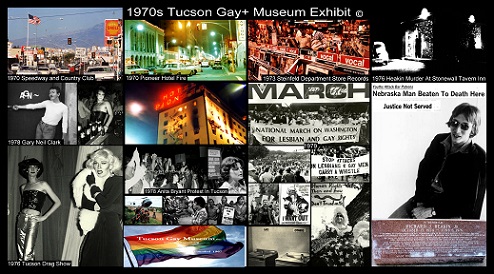
The push of the decade of the 1970's by Lesbians for a only Lesbian identity ran right along with the needs of many ethnic and minority groups of the time period to create their own private identities, which started such crossover subgroups as Black Lesbians, Chicana Lesbians, Russian Lesbians, Jewish Lesbians, and Asian American Lesbians to name but a few. Gay Men also were adding nuances to their identities and a new gay look arose in the United States which was that of the trim macho type man with a mustache. But, while the new masculine type gay look and actions blasted away the old mainstream stereotypes of homosexual men being limp wristed and feminine, that new image at the same time was alienating the many members of the Gay Community who were and or enjoyed being feminine. Dislike of the gender bending increased in the Gay population as new men with different ideas within the Gay world came in, which inevitably made self- expression and individuality by other gays sometimes even more difficult that it had been before as the decade closed on New Year's Eve in 1979. Over in Vietnam the capital city had fallen to the communists on April 30 1975 at the end of the war as the last American citizen left by helicopter. Tucson was stunned just after midnight in the early hours of December 20, 1970 when allegedly a teenage bus boy who worked at the hotel started two fires on the 4th floor hallway in the Pioneer International Hotel (see exhibit #1), a sometimes popular discrete Gay hangout, located at 100 N. Stone Avenue which trapped 28 people including some Gay Men trapped in their rooms without any possibility of escape. That bus boy however later in the 2010's was released from state prison in a government deal requiring him to Plead No Contest to the murders after the technology of that time period and a re-investigation failed to show any arson caused origin of the fire that night.
Tucson in 1975 saw two additional Gay Bars open up, the first named the River R located at 3686 E. Broadway Boulevard owned by a mix of investors on July 23 of that year, and the P.S. Club located at 2610 E. Fort Lowell Road on September 12, 1975 owned by the highly successful George E. Rederus (see... In Memoriam... page #6) who had a thing about people touching his clothes and ran the P.S. Club as the first after hours Gay Private Men's Membership Only Club in Tucson with a $7.00 cost to join and $5.00 each year to renew. The private club provided glasses and mixers, and members brought their own liquor bottles they could put in individual secured lockers. The P.S. Club featured a large dance floor and live disco, movies projected up onto large TV screens, and the fully stocked PX Adult Bookstore right inside the private club. On Friday The 13th in May 1977 the PS Club had already moved its entire operations downtown into the then Gay Owned Mac Aurthur Hotel , where rooms were $30/week-$90/month, located at 343 E. Toole Street and opened up that night with a change of its name to the Toole Box and adding its infamous Maze in the back. Also in 1975 the 1st Annual Gay Fair & Carnival was held at the Stonewall Inn bar at 2921 N. 1st Avenue over the 4th of July weekend that brought in huge crowds over the weekend enjoying the many carnival games, contests, rides, shows, fun, and music. The event became highly successful and drew car loads of festive Gay & Lesbian people coming in from Phoenix, many of whom left vowing to be moving to Tucson soon in order to enjoy the many Gay events in the Old Pueblo at the time.
On Wednesday September 29, 1976 the Tucson Gay Newsletter (T.G.N.), a one page typewriter written and then photocopied publication at first which quickly expanded , was distributed to all of the Gay Venue's and Gay Organizations in Tucson as a way to keep the Gay Community united and informed about the many daily-weekly-monthly happenings in the Old Pueblo. Quickly copies made their way to Phoenix and requests for advertising there came pouring in. The T.G.N. owners were made up of the former first Gay Bar & Cabaret owner in late 1950's Austin Texas, WW2 & Korean Conflict Navy Veteran, and Gibson's Stationers store manager, Robert (Bob) Bailie Ellis, the very talented George E. Rederus (see In Memoriam page #6), a true jack of all trades and practical joker, and Barney Robles, a former University of Arizona employee. The timing proved perfect as a local Tucson Gay news publication was exactly what Tucson's Gay Business Owners and the Public all desperately needed and wanted. The response was immediate and the publication soon grew with ever increasing local news and advertisers as the first and only such publication in Arizona at the time.
Then on
February 4, 1977 the publishing team, except for
Barney
Robles, a lover of those with pretty feet who had moved on, added
Larry Walters
as the representative down in Phoenix, who was later replaced
by Michael Morrow as the
Tucson Gay
Newsletter took things up to the next level changing the name of
the publication to the
Arizona Gay News (A.G.N.),
opening an office at 347 E. Toole Avenue,
and going not only statewide in
Arizona but also
including news articles covering
the Gay News of the entire
Southwestern
United States, and soon the
entire nation and
beyond. Later in
1978 one of the founding
members of the
Seattle Gay News,
Gary Neil Clark (see
article page 4),
visited
Tucson for a five (5) day vacation but quickly relocated to join the
Arizona Gay News staff.
Both publications were some of the the forerunners
to what would someday become the
Tucson Observer in the next decade
(see
1980's).
Around Tucson in 1976 the Lucky Pierre's bar located at 2222 N. Stone Avenue under the ownership of John Richtars, a former Oakland California lighting salesman, opened on Thursday April 22 1976 with weekly featured all you could drink beer for $1.00 TGIF Friday's between 7pm-9pm, The Back Door Baths & Bookstore located at 3909 E. Michigan Street in the industrial area near Davis Monthan AFB opened with owner Lloyd Wilson welcoming bathers with hamburgers-pizza-movies on February 9 1976. By November 1977 Lloyd Wilson was encountering lease problems with the property owner and the baths shut down on Saturday December 3, 1977 after having a 50% off sale on everything in the building. During the interim Lloyd Wilson and his then partner Fred Spencer had purchased the Atlas Baths in downtown San Diego (see article) where both men moved after the close of their Tucson business. The Gay Men's Rap Group met regularly at 1030 N. 4th Avenue, Gay AA - Live & Let Live Group met at the Gay Community Services Center (see article... page #8) at 627 N. 7th Avenue and the Grace Episcopal Church basement at 2331 E. Addams Street, the Hair Tiz bar owners Polly Stadelman and Dave Peppin remodeled before opening up the bar located at 343 E. Toole Avenue inside the Mac Aurthur Hotel, where the previous Gay Bar the Black Door had been located on January 19, 1976 and featured Wicked Wednesday's which quickly became extremely popular along with the formation of the Tricks For Lunch Bunch Club that formed and met regularly there where the bar regularly offered Bloody Mary's on Sundays for .50 cents.
Polly Stadelman and Dave Peppin in 1977 partnered with Norman F. Bloss living at 1415 W. Wetmore Road, together the trio bought the Mac Arthur Hotel (which later on February 21, 1979 was the scene of an arson fire (see article... page #1), it was originally built in 1909, and thus set the stage for Gay Businesses (see page #9) and Gay Clientele that would later utilize the facility in various ways. Tucson's first annual Closet Ball (see article... page #1) was presented by J.R. Nelson (a very energetic man who always seemed to be in motion and could himself be found in a dress at times) was held at the Hair Tiz bar to an overflowing crowd at 10PM the evening of Saturday November 19, 1977 to kick off the formation of the Building Fund for the Tucson Gay Community Services to buy or long term lease the property at 627 N. 7th Avenue. The 1st Annual Closet Ball winner's that night were 1st Place Roxanne (Roy 'Roger' Barger) and 1st Runner Up Coco Chanel (Peter Sittig) as both competed that fun filled night along with eleven (11) other contestants to raise $335.86 for the Gay Community Services Center located on 7th Street while seven (7) bartenders struggled to keep up with the crowds incoming bar orders. On Valentines Day Monday February 14, 1977 Lucky Pierre's bar closed and was put up for sale. Although qualified buyers stepped up, both the business and property became endlessly entangled in legal disputes between the out of town owners of the property, numerous lawyers, and the owners of the business and liquor license bringing things to a complete standstill. The deadlock was finally broken and on Tuesday May 17, 1977 as the property at 2222 N. Stone Avenue opened as the Front Runner (see article... page #1) bar complete with the latest commercial sound system shipped in from New York City under the ownership and management of David Sperry and Larry Altherr who had both moved up from Phoenix to open the bar. Also, during May 17 the Arizona Gay News (A.G.N.) (see article... page #2) moved into a downtown public location for the first time at the Gay Owned (see photo) Mac Arthur Hotel located at 343 E. Toole Avenue which contained numerous other Gay Related (see article.. page#1) businesses.
There was no other event that brought the Gays-Lesbians-Bisexuals-Transgendered of Tucson together as the Tucson LGBT Community more than the tragic-brutal-senseless murder of vacationing 21 year old Richard J. Heakin who on the early morning of Friday June 6, 1976 when leaving the Stonewall Tavern Inn Disco at 2921 N. 1st Avenue just south of Fort Lowell Road with friends, was attacked and beaten to death by some of the thirteen (13) local high school students involved as a group who had been looking for trouble all that night. The murderer(s) and accomplices were local 15 to 17 year old teenage boys who had been cruising Speedway Boulevard all the night before 'looking for homos to beat up'. All were underage, drinking alcohol, out past curfew, and taking drugs. Just after midnight, the four (4) car loads of high school students decided to go to the Stonewall Tavern Inn (see articles) with no other purpose than to 'fuck up some homos'. The savage attack that ended in murder was for no other reason than Mr. Heakin and his friends had just walked out of a Gay Bar.
Of the attackers who were arrested after fleeing to their homes and set to be tried as adults, only four young men, Charles J. Shemwell 17 of 3450 W. Potvin Lane, a student on the varsity football team at Marana High School and martial arts practioner, Herman Jesus Overpeck, 15 of 308 W. Jacinto Street, a freshman student on the football and wrestling teams at Ampitheater High School, Scott Mc Donald, 16 of 6645 N. Donna Beatrix Circle, a student at Amphitheater High School, and Russel Van Cleave, 16 of 1330 W. Knox Street, a student at Flowing Wells High School were the only ones ever charged with counts of first degree murder, conspiracy to commit 'aggrevated' assault, violation of being out past curfew, and were set to be tried as adults. The vicious group of high school age young men had been verbally and physically harassing other customers of the Stonewall Inn Tavern just prior to murdering Richard J. Heakin and attacking his friends. The bartender Bruce Cole working inside had no idea that the crime that would result in murder was unfolding just outside. At the Richard J. Heakin funeral well over 120 cars were counted in the procession to the cemetery that day. The Richard J. Heakin murder did push the City of Tucson on February 4, 1977 to become one of the first in the entire nation to pass anti-discrimination legislation based on sexual orientation. Sadly, the Heakin murder in Tucson was not an isolated incident as many Gays around the United States were also being targeted for bullying, beatings, or to be murdered in various cities and towns sometimes even by the police themselves. Almost a year after the Richard J. Heakin murder outside in its dirt parking lot, the Stonewall Tavern Inn co-owned by Tom Seward, who lived at 1216 N. Euclid Avenue, and John D. Morgan living at 2608A E. Fort Lowell Road was forced to close on Wednesday January 12, 1977 due to the very sharp drop in business and huge increases in the costs of insurance required to cover the bar's daily operation making it economically no longer possible to keep the doors open. The adjoining bar, the Back Pocket which had opened on Tuesday April 6, 1976 was much smaller and it remained open for business. The Back Pocket bar featured a fun loving bartender Larry Millins, a Canadian, who in his spare time trained Hollywood Actors how to ride horses for their movies at his rural place just south of town. In a turn of events, on Wednesday March 9, 1977 after a major renovation of the former Stonewall Tavern Inn bar including the dance area and interior, the property reopened under the ownership of Tom Steward as the Joshua Tree bar. By January of 1978 both bars were co-owned by Tom Seward (see article... page #2) and John D. Morgan who then sold the two bars to Bob Bishop Sr. living at 5741 N. Whilshire Drive and Vinny Cicciarelli living at 724 N. 2nd Avenue. One can visit the memorial to Richard J. Heakin located in Sunset Park just a few steps from the downtown Tucson City Hall.
The September 9, 1976 trial was presided over by Judge Ben C. Birdsall, the presiding judge of the superior court, who had previously been relieved of his judicial duties of a case (see article... #2...see paragraph #4) before in January of 1971 when he continually made damaging prejudical and predudiced statements to the press about the Pioneer Hotel Fire Arson trial that he was going to be the judge in (see article). His interference in the legal process was so reckless that another judge from a different Arizona county Judge Lloyd C. Helm of Cochise County was brought in to try that case. Only four (4) of the students ever stood trial out of the thirteen (13) students who were implicated or involved in the crimes and or who were accomplices in some way in the early June 6, 1976 morning murder of the young Gay man Richard J. Heakin. Judge Ben C. Birdsall in a surprise move quickly dropped the students charges from 1st Degree Murder down to Involuntary Manslaughter (often the charge when someone is accidently killed as the result of a car crash), and from being tried as adults to being tried as children. The judge then totally ignored the testimony of all the witnesses and ruled that he could find no evidence of malice or premeditation in the students actions that morning or the night before and gave (3) of the four accused simple probation (informal supervision by living at home, going to school ) for their savage attacks of anti gay hate and commiting murder partially due to their parents standings in the community, that the young men were athletes and good boys in school, Anti-Gay feelings by officials, and their parents abilities to work the legal system with all of their attorneys. The 4th student Scott Mc Donald was recovering from a football game injury gotten while he was awaiting trial, and was tried later with the same results of only informal probation. Judge Birdsall was quoted saying after the trial, "The four youths and their parents have been punished enough." The next day all of the youths involved were back in school still bullying the other students, had shaved their heads in solidarity, and paraded around together like heros who had murdered a Homo and gotten away with it 'Scott Free' as they joked around school." Coming together for the first time as a result, Tucson's Gays & Lesbians as a Community spearheaded through the efforts of the Tucson Gay Coalition began pushing back hard on Tucson and Pima County Officials for simply getting the basic legal protection-rights already afforded under Chapter 17 of the City Code to all other residents of the city, for hate crime laws, and to be represented on city boards and or commissions. Attempts by the Gay Community in Tucson were also made to recall (note bottom of page #6) Judge Ben C. Bridsall (see article... page# 4) from the bench and have him disbarred as an attorney but were never successful in the legal atmosphere of Tucson and Arizona during the time in the 1970's.
The Tucson Police Department on October 6, 1976 put out on the streets a Community Liaison-Safety Patrol (see article... October 6... page #1) consisting of two uniformed police officers Ken Magoch badge #6583 (later to become president of the local Fraternal Order of Police) and Mark Thomas badge #10900 (see article... page #2) under the guidance of Lt. Fuller. The officers regularly patroled Tucson's Gay Bars, their parking lots, and established friendly communication with the Tucson Gay Coalition (see article) , Gay Community Services Center, bar patrons & workers, performers, and bar owners-managers. On December 4, Adrian, Empress 1 de Arizona (see article... page #2) was honored at The Graduate bar for 30 years of female impersonation amist a standing room only very fun crowd that was treated to a full free buffet and show. On March 15, 1976 the Stonewall Inn bar held a grand opening of their Stoneynook outside patio and as fate would have it a very beautiful freak snowstorm blessed the crowd amid howls of excitment and enjoyment of natures special blessing as one patron shouted, "It's Our Special Blessing From Heaven." On April 4, 1976 the Tucson Gay Coalition was founded by Carmine Cardamone, later to become an Arizona State Representative, and Al DeLabio (see article... paragraph #5), for a time a leader of the MCC in Tucson, becoming the Old Pueblo's first Gay Political Organization. At that time in 1976 the only other public Gay organizations operating in Tucson were the Gay Students Organization (G.S.O.) (see article... page #3) founded by James Urhig and Phil Oliver (see photo-article... page #1) at the University Of Arizona that met in Room 350 of the Old Student Union Building, and the Truth Chapel Metropolitan Community Church (see article... page #3) located at 920 N. 1st Avenue. Soon after, the Gay Community Services Center Of Tucson (G.C.S.) (see article... page #3) was formed under the leadership of Norman F. Bloss living at 1415 W. Wetmore Road, who was also the weekend bartender at the Hair Tiz bar, and others including a core of MCC Church (see article... page #3) members, as Tucson's first non-bar facility for Gays & Lesbians as an all volunteer non-political and non-profit service to provide help with housing, medical and legal aid, and to operate a phone rap (talk) line open from 9am to midnight where callers could get help and advise for anything involving being Gay as a support mechanism for Tucson's ever growing Gay & Lesbian population.
The Gay Community Services Center (see article... page #1) soon held and partnered numerous food drives in many Gay Venues (see article... page #1) in Tucson with the items received given to the Community Food Bank as a Member Agency in the name of the entire Gay Community, had put a member on the Community Food Bank's Advisory Council , and sponsored a free monthly VD Prevention and Testing Clinic (STD's) (see article... page #2) for the Gay Community at the downtown Tucson Free Clinic located at the corner of West Franklin Street and Granada Avenue. The group also had some of it's members trained in taking blood samples and other tests to allow Gays to be treated by Gays. On Sunday October 24, 1976 the Gay Community Services (see article ...page # 4) held their First Annual Fundraising Picnic & Pool Party (see article... page #4) featuring free beer, BBQ hot dogs, and other foods raising $200.00 to pay their Tucson Gas & Electric Company, Mountain Bell Telephone utility bills, and rent. Soon after, on Monday December 13, 1976 the Gay Community Services Center (see article...page #7) opened up its walk-in location at 627 N. 7th Avenue, while at the same time across town the mixed bar H & L Friendly Tavern (Hard & Long) (see article... page #3) located at 1906 S. Craycroft Boulevard opened just up the road from the main gate of Davis Monthan A.F.B. with owners Bill and Barbara along with bartenders Jim & Rusty attracting hordes of young military men as well as women assigned at the A.F.B. The Imperial Court of Tucson was officially inaugurated on the night of October 30, 1976 when Emperor l Fernando Ochoa and Empress l Cicely were crowned before a very festive and joyous crowd of just over 600 people at Jekyll's & Hydes bar (disco). Their royal court included Grand Duchess l Mahogany, and Lord Prime Minister Budd (Bud) Sherrick.Cocktail hour prices that night for drinks were .40 cents for a well drink, .25 cents for a large glass of draft beer, and .40 cents for a domestic bottle of beer. March 31, 1977 awoke to a large contingent of Tucson's Gay Community traveling up to the State Capitol in Phoenix (see articles... page #1, 2, 3, 7) (see photo above on left) to protest the planned revision of the state's criminal code to further allowing cracking down on and helping make it easier to prosecute all Gays in Arizona. Jekyll's & Hydes provided a commercial bus for free, and the mood was slightly beyond festive on the ride going both ways. At the Arizona State Capital that day well over 600 Gays from all around Arizona joined in on the protest.
In a ground breaking event on Thursday April 14, 1977 the first of four (4) Gay Film Forums (see article... page #1) that featured three (3) films (Dichotomy, Sandy and Madelaine's Family, and Homo Movie) on Homosexuality that were sponsored by the Tucson Public Library and funded by the Arizona Council On The Humanities was held at Rincon High School in the auditorium with a discussion period between the public and a panel that included Beverly Gian of the Tucson Gay Coalition (T.G.C.) after the films. Around town on June 13, 1977 the First Christian Church Of Tucson by a 93 to 53 vote by its congregation (see article... page #3) denied the Truth Chapel Metropolitian Community Church from using their facilities, Police arrests of Gay Men at Himmel and Reid Parks were sharply increasing by officers in full uniform who were also responding to reports of Gay Men being attacked and robbed (see article... page #7) in those parks. On July 14, 1977 the Morning Star Cafe (see article... page #2) opened at 1930 N. Miracle Mile with owner Thomas Swanson (see... photo... page #1) personally managing the operation. The opening day of the Morning Star Cafe was so successful its food supply was quickly totally overwhelmed by the huge Gay crowds that showed up. Excellent food was served up in the front of the cafe, and its location near some of the hottest Gay bars made it an instant success, while in the back room area it was Hot Action where everything being served (see menu advertisement... page # 2) did not always appear on the cafe's menu. Dignity/Tucson founded as an Arizona Corporation and IRS approved 501 (3) C tax exempt organization (the first Gay one in Arizona) on August 14, 1977 by Ray Birmingham and Bruce Fowler for Gay Catholics (see article..... page # 2) in Tucson (see... page #6) at the University of Arizona Campus Christian Center 715 N. Park Avenue featuring a celebration of Mass and Potluck dinner (Dignity had been formed nationally in 1973) . Around the same time Integrity (Episcopal) and Affirmation (Mormon) formed Gay groups, but both had disbanded after 3 months. Friday August 19, 1977 persons unknown spiked a well know member of the Tucson Gay Community's non-alcoholic drink with LSD at the Last Culture Disco when he stepped away to the bathroom. Fortunately, he experienced a bitter taste that stopped him from drinking more. Both the man and the drink were taken to St. Mary's Hospital for waiting medical and law enforcement officials. Laboratory testing of the drinks contents showed the drug was uncut and contained well over the normal dose of LSD.
Sunday June 26, 1977 saw Tucson's first Gay Pride Picnic/Heakin Memorial in the S/E corner of Himmel Park which was partially in celebration of the national (see article...page #7) Gay Pride Day that was itself in part a remembrance of the Stonewall Riots in 1969 (see 1960's), but more importantly locally in memory of the murder of 21 year old Richard J. Heakin. The first Pride Picnic in Tucson brought out 61 people, seven (7) guitars (guitarists included Stephanie Bader, Deb Halstead, Anne Schmitt), lots of Kentucky Fried Chicken thanks to Denise Duckwiler (see letters...page #8), some conga drums, five (5) dogs, a two (2) foot python & a parrot at the all free Himmel Park event which was put together by the Tucson Gay Coalition and other Gay Community Members who had the idea that day to bring along a volleyball net and a couple of squirt guns filled with 100 Proof Southern Comfort. Speakers denounced the anti-gay atmosphere that existed around town within many of Tucson's population, court system, the state & national politicians, along with some openly gay bashing city officials. Some of crowd played live music on their guitars and other instruments including two (2) flutes, everyone was free to dance & throw frisbees, they brought their own food, water, bbq's, beer or wine, blankets to lay on, and tarps for shade. October 24, 1977 (see editors article... page # 10) saw the Tucson Knight Owls (T.K.O.) founded by Dale Mc Kissick and Lee Ridinger as the Old Pueblo's first Levi-Leather men's social organization and quickly became very active in the community sponsoring Gay Themed shows, outdoor outings, and many other fundraising events. La Casa Nuestra located at 2433 N. Dodge Boulevard first opened as a facility for Gays & Lesbians on Monday November 28, 1977, then later changed its format to primarily a facility for Feminists under the owner and manager Cathy Hemler. The first Community Meeting for Tucson's Gay & Lesbian groups-organizations-businesses was held on Friday December 16, 1977 at the Gay Community Services Center (see article... page #2) located at 627 N. 7th Avenue in an attempt to open communications to avoid duplication of efforts, assist in each other's functions, and better coordinate together as a group. The meeting included representatives of all the Gay Bars and other Gay Businesses, Tucson Gay Coalition (T.G.C.) (see article... page# 2), Gay Community Services (G.C.S.) (see article... page # 2), Imperial Court de Tucson (see article... page # 1), Gay Students Organization (G.S.O. at University of Arizona)(see articles... page # 1, 6, 10), both Metropolitian Community Churches (M.C.C.) (see article... page # 3), Dignity (Gay Catholics) (see article... page #10), Integrity (Gay Episcopalians) (see article... page #2) , Gay Alcoholics Anonymous (see article... GCS... page #8), Arizona Gay News (A.G.N.), Gay Men's Rap Group (see... Calendar Wednesday...page # 7) , and the Parents Of Gays (see... Calendar Thursday...page # 6).
Elsewhere in 1977, the openly Gay Harvey Bernard Milk (after his three (3) other unsuccessful elections in the city), a U.S. Navy Veteran during the Korean War (see 1950's) was finally the first such person of the Gay & Lesbian Community there to be elected to the San Francisco Board of Supervisors. During his short 11 months time in office which ended with his assassination, he helped raise the viability and visibility of Gay issues all around the United States. Unfortunately, Supervisor Harvey Bernard Milk was assassinated along with the mayor George Moscone by Daniel James White who had a history of violence and was a former fellow San Francisco Board of Supervisors member serving with both men just days before. Dan White had resigned in a fit of anger just 10 days before noting he did not like city politics, and could not make enough money as a San Francisco Supervisor. A few days later White unbelievably asked the mayor to forget all about his resignation and appoint him back onto the Board of Supervisors. That request of course was not done, and the mayor refused to see White. The assassin, Daniel James White was a former San Francisco police officer and a former San Francisco fireman, who openly hated Gays and Lesbians. Both the Mayor and Harvey Bernard Milk did not share Daniel James White's hatred of others and were his political opposites. On the morning of November 27, 1978 at Supervisor Milk's office in the city hall in San Francisco, Daniel James White infiltrated in through an open window he found to get past the buildings metal detectors with his San Francisco Police Department issued and fully loaded automatic pistol along with an extra 10ea rounds of hollow point ammunition made to cause maximum damage to human flesh and organs, and assassinated Harvey Bernard Milk because he was Gay and trying to gain basic human rights for all gay people. The last two bullets White fired were with the pistol right up against Supervisor Harvey Milk's skull in an obvious hate filled assassination. White was later only convicted of voluntary manslaughter and served only 5 years for both assassinations /murders (although later it was proven he actually had 4 supervisors on his hit list that day including then city supervisor Dianne Feinstein) and committed suicide in his garage in San Francisco the next decade on October 21, 1985. After the hand slap verdict of the murder trial, the White Night Riots erupted around city hall that night injuring 61 police officers and 100 Gays and Lesbians. A few hours later a group of police stormed in a Gay bar and physically assaulted every single one of the customers with Billy clubs, black jacks, pistol butts, and their fists just as soon as they stormed in. Harvey Bernard Milk's name quickly became known worldwide as he was celebrated, remembered, and is recognized as a true martyr of the gay rights cause in the United States.
On Monday night at 6:00pm February 20, 1978 the Anti-Gay Homophobe Crusader Anita Bryant made an appearance and performance in the nationally announced Bible Fire (see article... 'Perspective'... page # 7) as part of the Revival Fires Crusade held at the downtown Tucson Community Center Arena (later renamed the Tucson Convention Center (T.C.C.) located at 260 S. Church Avenue. Once inside when the Revival Fires Crusade audience were all asked to donate $100.00 each, large numbers of them stood up and walked out (see articles... pages # 1, 2, 5, 13). For three (3) weeks prior to the Bible Fire event, Tucson mobilized both Gays and straights into the Tucson Human Rights Coalition of Box 4813, Tucson 85717 (founded and organized by Ms. Beverly Ginn (see article-photo... page #11) , a Tucson attorney with her office at 23 E. Mc Cormick Street, and Bill North (see article-photo... page #11), along with the help of Ric Wilson (see article-photo... page #11) . An organizational training session and rally was held at the N/E corner of Himmel Park on a cold misty Sunday February 12, 1978 afternoon. Training included the arts of peaceful demonstration, how to take being hit by rocks-bottles-clubs, how to sing group love songs to angry hecklers, and much more. Provisions were made to set up free transportation roundtrip from Phoenix (see page # 9) for everyone who wanted to stand that night with the Coalition. With organizational ideas from a representative of the National Gay Task Force, the Human Rights Rally (see... page #6) that night by the Tucson Human Rights Coalition (see articles pages # 1, 2, 5, 13) was a resounding success as over 1,000 peaceful people both Gay & Straight (see articles pages... # 1, 2, 5, 13) stood in a large area outside the religious revival event listening to Gay Speakers & Entertainers (see articles... pages # 1, 2, 5,13), waving signs, and singing songs of peace & love to screaming Anti Gay Hecklers (see articles 1, 2, 3). As a result of her crusade in Tucson, Anita Bryant lost all of her church bookings nationwide.
In Tucson the dark midnight of Friday January 6, 1978 the Rocky Horror Picture Show made its first debut in the Old Pueblo at the Loft Cinema, and ran continuously for many years later always attracting intensely loyal crowds. By the end of the 1970's, as the stroke of midnight on December 31, 1979 saw a new decade coming, Tucson's population within the city limits had grown to 320,537. In the meantime, 55 U.S. Citizens were being held as hostages during a revolution in Iran, the Disco era was fading fast, Antigone Books was going strong at 415 N. 4th Avenue, Tucson's Gay Bars put on New Years shows that drew hundreds of fun seeking party goers, the Muppet Movie was shown in local theatres, President Richard Nixon & The First Lady were gone in disgrace, President Gerald Ford had stumbled his way off from the public view, President Jimmy Carter was on his way out of the White House and Ronald Reagan was on his way in, the first national Homosexual Rights March of over 200,000 Gays (including a delegation from Tucson) was held in Washington D.C. (see articles... pages # 1, 18), across the nation openly Gay Men were recruited and hired as policemen by the San Francisco Police Department, the rainbow flag was first used as a symbol of Homosexual Pride, the president's mother went to Studio 54 in New York City and loved all the Gay Men there, Gay Community Services (see article... page # 4) in Tucson operated a free VD Clinic (STD's) at the Gay Owned and operated Mac Arthur Hotel 345 E. Toole Avenue.
Skate O Rama located at 2700 N. Stone Avenue was a very popular Gay hangout, advice columnist Ann Landers got divorced and publicly stated "Some of the best school teachers I know are Gay!", on March 26, 1977 the National Gay Task Force met with the president's assistant inside the White House presenting a petition asking the president to sign an Executive Order (see... listing... March 26,1977) banning discrimination (see... listing... May 21, 1976) against Gays & Lesbians in Federal employment, the money and toys collected from benefit events and collection boxes at all of the bars in the Tucson Gay Community for the U.S. Marines annual Toys For Tots Program were all refused because they came from a Homosexual Organization with the story making the national news , 8 Track tapes and decks were on the way out, a partial core meltdown occurred at the 3 Mile Island Nuclear Plant, the average price of a new home in Tucson was $62,000.00 as real estate prices had already tripled in just three (3) years (see article), Tucson was wondering where its growing need for water would be coming from, Howard Hughes died owning over 8% of the Tucson area including his sprawling ranch named Rita's Ranch, meantime traffic jams and air pollution began to appear, and the Supreme Court of the United States refused to hear (see article... page #7) any cases about Homosexual rights (see article... page #7). Around Tucson, gone into history were the Stonewall Inn Tavern, River R bar, Lucky Pierre's bar, P.S. Club, Front Runner bar, Back Door Baths (bath house) (see... advertising... page #9). FAIR USE NOTICE:This site contains copyrighted material the use of which has not always been specifically authorized by the copyright owner. We are making such material available in our efforts to advance understanding of environmental, political, human rights, economic, democracy, scientific, and social justice issues, etc. We believe this constitutes a “fair use” of any such copyrighted material as provided for in section 107 of the US Copyright Law. In accordance with Title 17 U.S.C. Section 107, the material on this site is distributed without profit to those who have expressed a prior interest in receiving the included information for research and educational purposes. For more information go to: http://www.law.cornell.edu/uscode/17/107.shtml. If you wish to use copyrighted material from this site for purposes of your own that go beyond “fair use,” you must obtain permission from the copyright owner, including the Tucson Gay Museum®© and provide an acknowledgement-link back to this site as a professional courtesy. Publication of names, photos, exhibits, manuscripts, artifacts, memorabilia of any person or organization in the TUCSON GAY MUSEUM a.k.a. Tucson LGBT Museum and Tucson LGBTQ Museum is not to be construed as indication of the sexual orientation of such person(s), organization(s), advertisers, or any employees thereof. This Museum is dedicated to all those of the Tucson LGBT Community that have come before, are here now, and will take our places in the future of Tucson, Arizona, U.S.A. Home | About The Museum | Explore Exhibits | Visit Special Collections | Site Map | Disclaimer
|